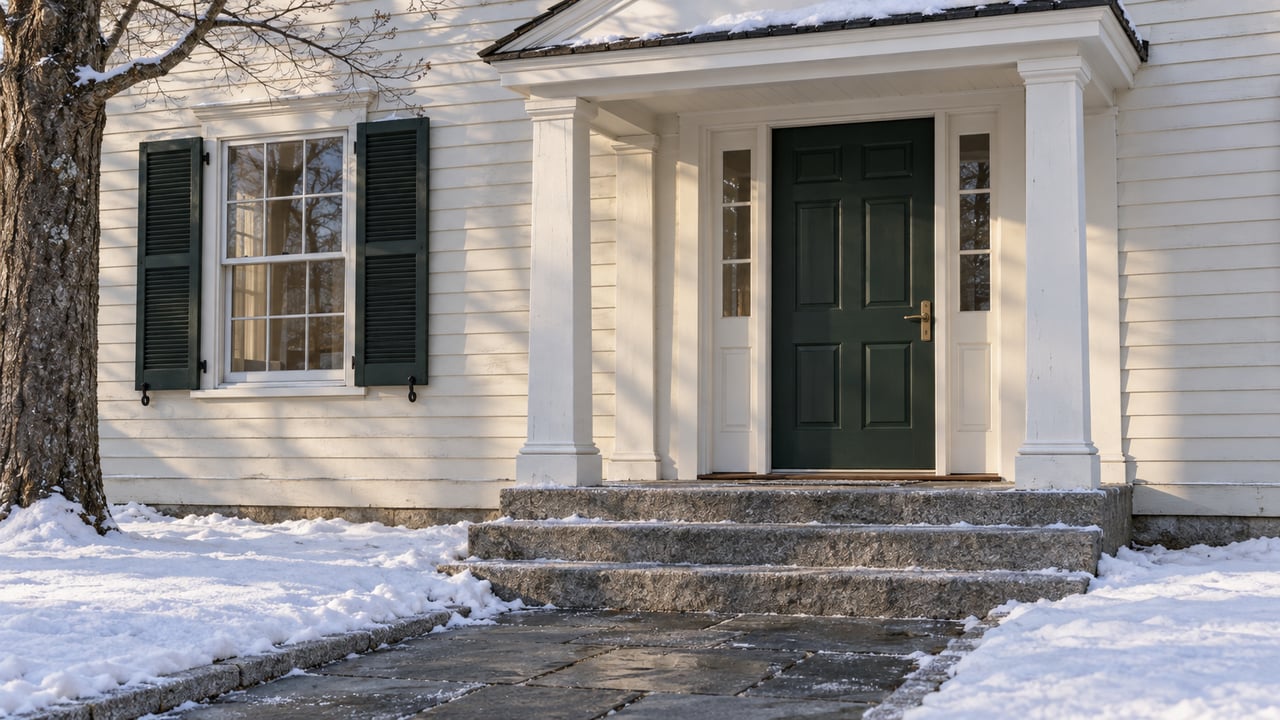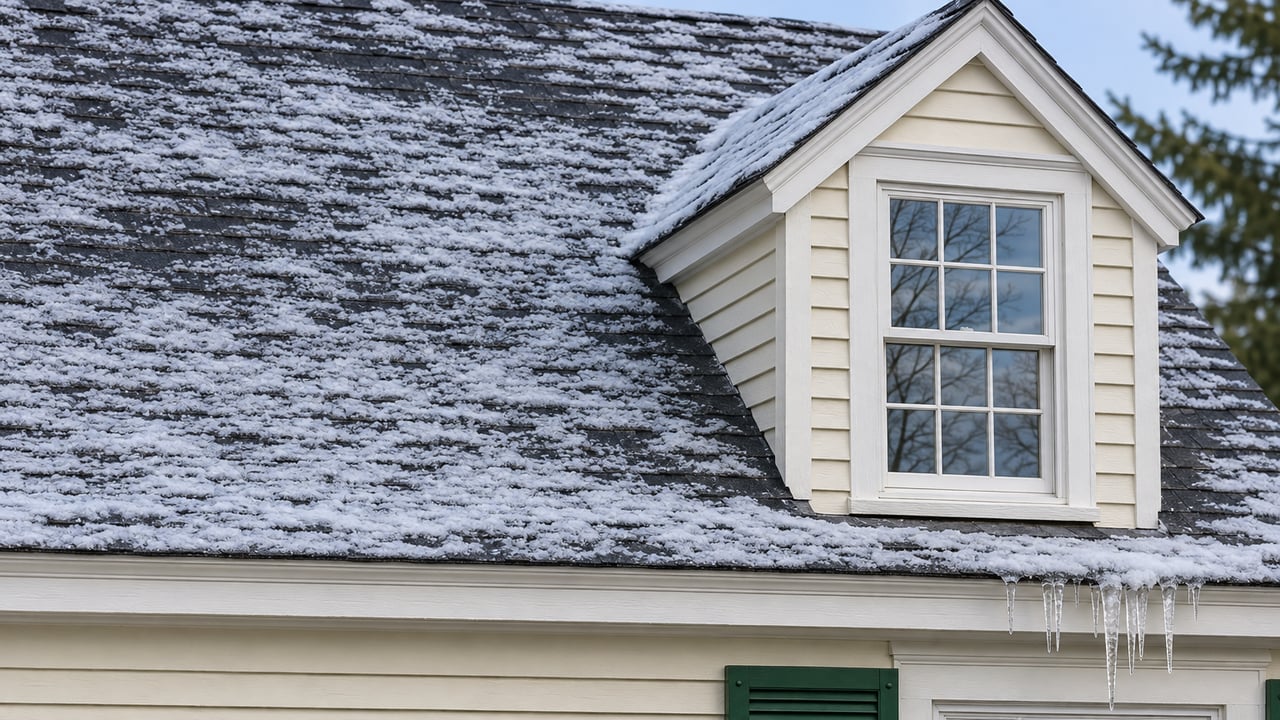
Here is a common sight at a winter showing around Bangor. The driveway is plowed and the walk is salted, and the steep roof of a story-and-a-half Cape still holds snow. A row of icicles hangs from the eaves, and above the gutter line sits a ridge of ice a few inches thick. Inside, the upstairs bedrooms have sloped ceilings, short knee walls, and small access doors to the crawl space behind them.
That ice is a question about the attic, and on a Cape the attic is several spaces, each needing its own work. Getting a contractor's price for all of them before your inspection period ends is what keeps the icicles in the negotiation and out of your first spring in the house.
What the ice on the eaves can and cannot tell you
An ice dam forms when snow on the roof melts and the water gets trapped at the edge and refreezes overnight. The melt can come from the sun or from heat escaping through the roof. Matt Cronin, who owns Harbor Shore Landscaping in Orrington, explained the damage to the Bangor Daily News in December 2025: "Water expands when it freezes, so that ice works into the shingles and separates them from the roof, which exposes the nails and causes leaks." In the same article, he said roof valleys formed by dormers, which some older Colonial-style homes have, collect snow and make a house especially prone to ice dams.
Cronin also told the BDN that the Bangor region doesn't see much demand for roof clearing anymore, because it doesn't get the snow it used to. Around here, the weight of the snow is less of a concern than where the meltwater goes.
Sun alone can melt snow, so icicles on a south-facing eave in February don't prove an attic problem. They do give you a fair reason to ask questions. Look at whether the ice sits mainly over the heated rooms, and whether the snow is gone from the upper roof while it stays on the garage or porch next to it. Then ask the seller's agent whether the house has had leaks at the ceiling below the eaves, and whether anyone has looked behind the knee walls. Our post on how we review inspection findings on Greater Bangor homes covers how those answers get documented.
Why a Cape's attic is really four spaces
Most houses have one clear line between heated and unheated space, and it's the attic floor. A Cape's second floor sits partly inside the roof, so it has several separate boundaries: the knee walls, the sloped ceilings along the rafters, the small flat attic above the upstairs ceiling, and the floor-joist cavities where the knee wall meets the floor. Horizon Homes, a Maine weatherization contractor that says it sees more Capes than any other style, writes that builders in the 1940s and 1950s often insulated only the flat attic and left the knee walls, sloped ceilings, and joist cavities bare. The same contractor says it sees more ice dam damage in Capes than in any other style, and it ties those dams to heat escaping through the roof.
That changes what you're pricing. Blowing more insulation over the flat attic is the easy part, and it doesn't touch the knee walls or the sloped ceilings above the bedrooms. Horizon recommends sealing the air leaks first, at the electrical boxes, wire holes, and the joint where the knee wall meets the attic floor, before any insulation goes in. The sloped ceilings set a limit of their own. In many older Capes the rafter cavities are only 5.5 inches deep, and Horizon puts dense-pack cellulose in those cavities at roughly R-20.
Greater Bangor has plenty of housing from those decades. Bangor Gardens, between Broadway and Husson University, went up in the 1950s as housing for service members at Dow Air Force Base and their families, and the BDN's history of Bangor neighborhood names describes its homes as compact and quickly built. Any house of that age is worth the same questions about its attic, whatever its roofline.
What the whole job costs on a Cape
Horizon Homes describes a complete Cape project this way. It includes air sealing at the attic floor, knee wall junctions, joist cavities, rim joists, and penetrations, dense-pack cellulose in the knee walls and sloped ceilings, loose-fill cellulose in the flat attic, blocking at the joist cavities, and basement insulation. Its estimate for that work is $8,000 to $15,000 before rebates, depending on size and condition. That's one contractor's range, and the guide was first published in 2023. On its insulation services page, Nason's Home Solutions, which works in the Bangor area, gives $2,500 to $10,000 as a typical Central Maine range for attic, basement, or wall insulation before rebates, with square footage, materials, and air sealing driving the cost.
The gap between those two ranges is the gap between fixing part of the house and fixing the whole envelope. On a Cape with ice over the bedrooms, the knee walls and sloped ceilings usually decide which end of the range you land on. A quote that lists each of the four spaces separately tells you more than one lump-sum number.
Efficiency Maine changed its insulation and air-sealing rebates for work completed on or after October 1, 2026, moving from a percentage of project cost to fixed amounts for each zone of the house. The current amounts are on the Efficiency Maine rebate page. Contractor guides and rebate examples written before that date no longer match it, and Horizon added a note saying so to its own Cape guide in October 2026. Ask any contractor you call to price the job under the current program.
Steaming off an ice dam is a separate cost, and it doesn't fix the cause. 3 Little Birds, a Greater Portland company, posts a rate of $800 an hour and says most jobs take about three hours, with most estimates landing between $1,600 and $2,400. Treat that as a statewide benchmark, not a Bangor quote.
Getting a number before the inspection period ends
The calendar matters in a winter purchase. Efficiency Maine's October 28, 2026 board report says the top registered vendors offering insulation reported a 45-day backlog, up from the month before. A buyer who calls after a December closing could be waiting until well into the new year for installation. Calling during the inspection period gets you a quote you can use while you're still negotiating, even if the work itself has to wait. The program's vendor locator lists the current roster of registered vendors.
Several firms advertise this work in the Bangor area. Mattra, based in Lewiston, lists Bangor as a service city, does blower-door tests, and includes ice dams on its intake form. Webb Insulation in Houlton serves Penobscot County and does energy audits that include blower-door testing. Thermal IQ lists Bangor among the places it serves and does blower-door testing. TC Hafford Basement Systems is the Bangor-area contractor for Dr. Energy Saver audits. A blower-door test and a written quote from any of them turn an icicle into a dollar figure, and that figure can go into your offer instead of becoming a surprise in March.
The same envelope problems show up in the heating bill. Our earlier post on what the gallons on a heating disclosure cost this winter covers that side. Horizon writes that a Cape burning 900 or more gallons of oil a year almost certainly has an envelope problem.
Quick answers
Does a house with icicles mean the attic is bad? Not by itself. Snow melts from sun as well as from escaping heat, according to Cronin's explanation in the BDN. Ice over the heated rooms, combined with signs of past leaks, is the stronger signal.
Will steaming the ice fix the problem? Steaming clears the dam from the roof. The heat loss that formed it is in the attic, and that's where the larger repair is.
The contractor ranges above are general information as of their dates, not legal, tax, or financial advice. Confirm your own figures with a contractor and with Efficiency Maine before you count on a number.
If the Cape you toured this week had ice on the eaves, James can walk the attic with you and help you get a contractor's number into your offer before the inspection period ends. Reach out to James A. Spear at True North Realty. Stop Dreaming. Start Doing. Schedule a Consultation.